
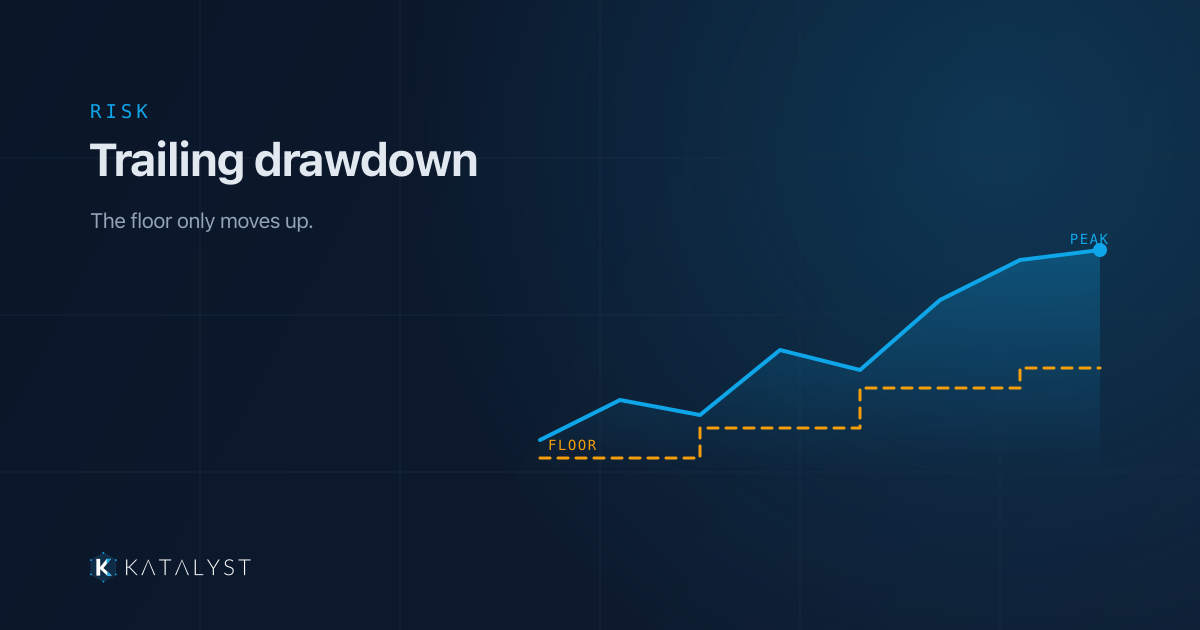
Most traders blow their first funded account without ever hitting a loss limit. They breach the trailing drawdown — a floor that quietly rises underneath them while they’re focused on the target. It’s the least understood rule in prop trading and the most expensive one to learn by accident.
How the floor actually moves
A static drawdown is simple: a $100,000 account with a 10% max loss has a floor at $90,000 for the life of the account. Cross it and you’re out. That’s it.
A trailing drawdown follows your equity’s high-water mark. Every time your account prints a new peak, the floor rises with it:
- Equity hits $110,000 → floor rises to $99,000.
- Equity hits $120,000 → floor rises to $108,000.
The floor ratchets up but never comes back down. Which leads to the detail that catches everyone:
You can be up $7,000 on the account and still breach trailing drawdown. The rule doesn’t care that you’re green — it cares how far you’ve fallen from your peak.
The trap: giving back an open winner
Here’s where most breaches happen. Many firms trail on intraday equity, not just closed balance. That means an unrealized peak counts.
Say you’re up $2,000 on an open position. Your equity high-water mark just moved, and the floor moved with it — permanently. If you let that winner round-trip back to breakeven, you’ve handed the account $2,000 of drawdown room for a trade that closed flat. Do that a few times and the floor has crept up to within a few ticks of your balance, and a single normal loss ends the account.
This is why “let winners run” is dangerous advice under a trailing rule. Runners are good; giving them all back is what kills you. Taking partial profits and moving to breakeven protects the high-water mark from ratcheting the floor into striking distance.
Four habits that keep you clear of the floor
1. Know your buffer in dollars, right now. Not “I have a 10% drawdown.” The number that matters is how many dollars of loss am I from the floor at this exact moment. That number shrinks every time you make a new high.
2. Bank partials on runners. Locking in profit on part of the position prevents an open winner from inflating the high-water mark and then evaporating.
3. Size down as the floor tightens. Early in an account the buffer is wide. After a strong run, the floor is close behind your balance — that’s when to trade smaller, not bigger. Model it first with the risk/reward simulator and set your contracts with the position size calculator.
4. Respect the reset time. Daily floors recalculate at a fixed server time. Know it. A trade that’s fine at 11:58 can sit on the wrong side of a reset at 12:01.
Watch the high-water mark, don’t guess at it
You can’t manage a floor you can’t see. The problem is that trailing drawdown is a running calculation off your equity peak — and reconstructing that from broker statements after the fact is useless. You need it live.
That’s a journaling job. With automatic Rithmic sync, every fill flows into Katalyst as it happens and scheduled syncing keeps the account current between sessions. Your equity curve then shows the peaks that set your floor — and the pullbacks that eat your buffer — so the drawdown stops being an invisible cliff and becomes a line you can actually see coming.
| Account equity | New high-water mark? | 10% trailing floor |
|---|---|---|
| $100,000 (start) | — | $90,000 |
| $108,000 | Yes | $98,000 |
| $103,000 | No | $98,000 (held) |
| $115,000 | Yes | $105,000 |
Notice the third row: equity fell $5,000 but the floor held at its peak-based level. That gap between your balance and a floor that only moves up is the entire game.
Trade the cushion, not just the target
The traders who keep funded accounts think in cushion, not in target. They know their dollar distance to the floor at all times, they bank partials so open winners don’t ratchet the floor against them, and they size down when the buffer gets thin.
Connect your account to Katalyst, keep your equity curve live, and stop letting the silent killer sneak up while you’re staring at the profit target.