
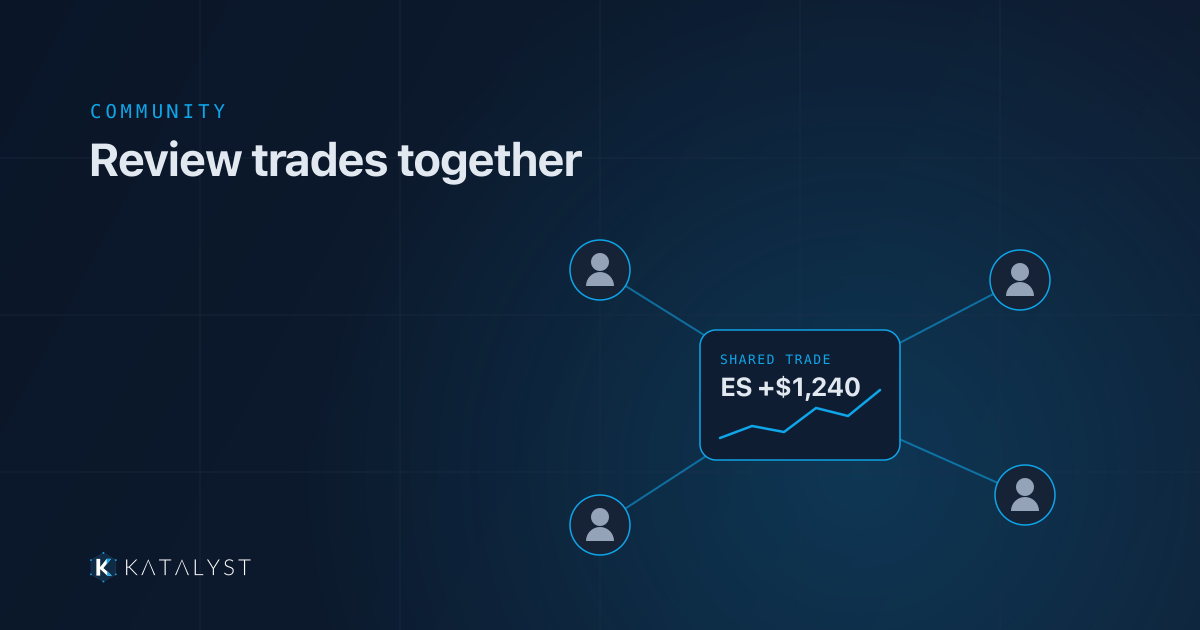
Trading is one of the few skilled professions people attempt in complete isolation. A surgeon has rounds, a lawyer has a firm, an engineer has code review — but most traders sit alone, grade their own homework, and wonder why the same mistakes keep resurfacing. The fastest way to break that loop isn’t another indicator. It’s other traders who can see what you can’t.
That’s what Katalyst trading groups are built for: a private space where real traders review real trades together, with real P&L on the table.
What a Katalyst trading group actually is
A trading group is a shared workspace where members post trades, discuss setups, and hold each other accountable. Unlike a public chat room full of screenshots and hindsight, a Katalyst group is anchored to actual data — the trades and P&L members choose to share come straight from their journals, not from memory.
You can run a group as:
- Private — an invite-only circle of trusted traders or a mentor’s inner cohort.
- Public — a discoverable community around a strategy, instrument, or market.
Owners control exactly how much gets shared. Members can post full trade details, P&L only, or a curated selection — so you can be transparent about results without exposing every position in real time.
Why shared review works when solo review stalls
When you review your own trades, you bring the same blind spots that produced them. You rationalize the loss, credit yourself for the lucky win, and skip past the uncomfortable pattern. A group breaks that.
- Other people see your tells. The revenge trade you’d excuse in your own journal is obvious to someone watching your feed.
- Accountability changes behavior. Knowing your group will see the trade makes you think twice before breaking your own rules.
- Good ideas compound. A setup that’s marginal for you might be someone else’s bread and butter — shared review spreads what works.
The market is happy to teach you the same lesson a hundred times. A group of traders who can see your trades will teach it to you once.
Structure that keeps a group productive
Communities die when they turn into noise. Katalyst groups are built to stay focused:
- Role-based access — Owner, Manager, and Member roles keep moderation and permissions clean as the group grows.
- Events and calendar — schedule trade-review sessions and market prep so the group has a rhythm, not just a chat.
- Sub-groups — split focused topics like risk management, a specific instrument, or a strategy into their own space.
- Shared files and guides — keep playbooks, chart templates, and educational content in one place instead of scattered across DMs.
- Slack and Discord webhooks — pipe shared trades, events, and announcements into the tools your community already lives in.
The point of all of it is signal. A group should make each member’s review sharper, not bury them in messages.
For mentors and group owners
If you teach, a Katalyst group is also a place to run your practice. You can share guides, host review events, and — when you’re ready — attach offers and promotions so the community you’ve built can become part of how you earn. The mentorship happens on top of real data, which is exactly what makes it credible.
Trade with people who can see your trades
Isolation is the tax most traders don’t know they’re paying. Reviewing alone means your worst habits get a private audience of one — you, the person least equipped to spot them.
Create a trading group, invite the traders you actually learn from, and put your real trades in front of people who can help you read them. You’ll find your edge faster with a few sharp sets of eyes than you ever will alone. Explore everything trading groups can do and start building yours.