
Once a trader passes one evaluation, the obvious next move is to run several accounts at once. In 2026 most major futures prop firms explicitly allow it, and stacking accounts is the fastest legitimate way to raise your payout ceiling without risking more of your own capital. The catch: every account you add multiplies your bookkeeping and your chances of tripping a rule you forgot you were subject to.
Every account is its own island
The single most important thing to internalize: rules are tracked per account, not pooled. Each funded account has its own:
- Trailing or static drawdown floor
- Daily loss limit
- Consistency threshold, checked at payout time
Copying a trade across five accounts doesn’t share the burden — it means five separate accounts each need their own single-best-day under the consistency cap before that account can pay. A day that’s perfectly consistent on Account A can blow the distribution on Account B if the fills landed differently. You’re not managing one system with five copies; you’re managing five independent systems that happen to take similar trades.
The mistake that ends multi-account runs isn’t a bad trade — it’s assuming a rule you cleared on one account is cleared everywhere. Each island is checked on its own at payout.
Where copy trading crosses the line
Copy trading is where funded traders get their payouts denied, so know the boundary cold:
- Internal copy trading is allowed. Mirroring your own orders across accounts you own is fine at nearly every futures firm.
- External copy trading is prohibited. Subscribing to a signal service, or letting someone else trade your funded account, is classified as group trading regardless of how the software is configured.
Firms enforce this with IP fingerprinting and millisecond timestamp matching. When two orders share an IP and fill within ~10 milliseconds of each other — especially across different owners — accounts get flagged and payouts frozen. Keeping accounts in your own name, on your own infrastructure, is what keeps you compliant. The rule isn’t “don’t copy your trades.” It’s “don’t share your trading with other people.”
The real challenge: keeping the numbers straight
Here’s what nobody warns you about scaling: the trading barely changes, but the accounting explodes. Five accounts is five drawdown floors to watch, five consistency distributions to track, and five sets of fills to reconcile — and doing that by hand across five broker statements is how mistakes happen.
This is a data problem, and it’s the one Katalyst is built for. Connect each account through Rithmic sync and every fill from every account flows in automatically, with scheduled syncing keeping all of them current between sessions. No exports, no five-way spreadsheet reconciliation.
From there, tag each trade by account and the pivot grid becomes your command center. Slice by account and you can answer the questions that actually keep the accounts alive:
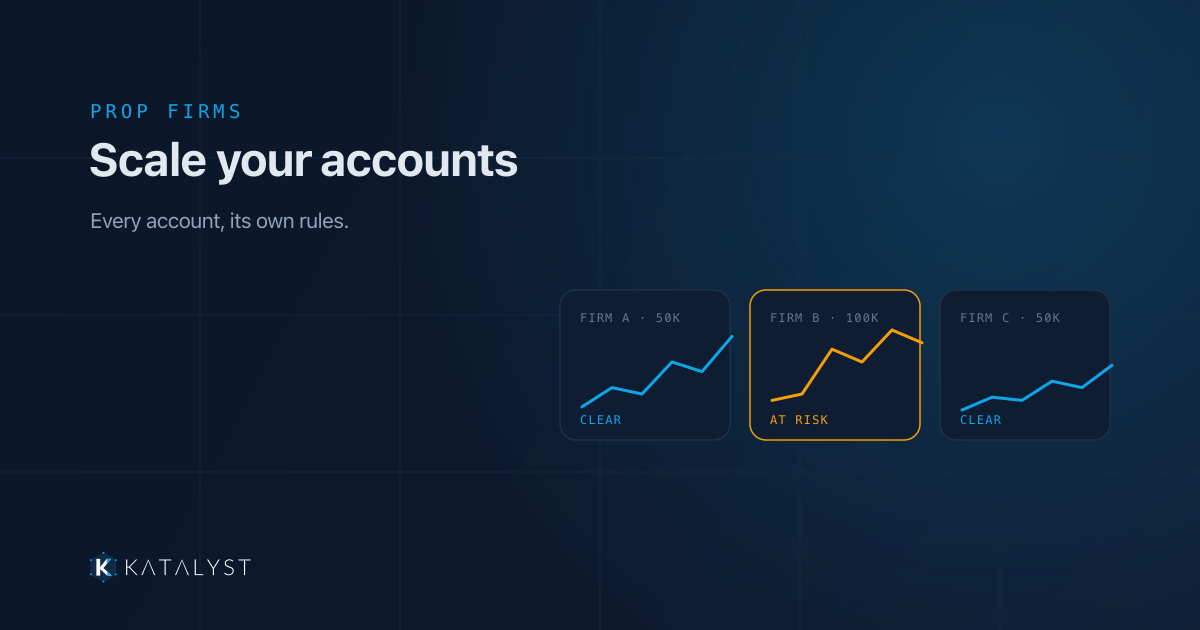
| Account | Cumulative P&L | Best day | Best day % | Consistency (30% cap) |
|---|---|---|---|---|
| Firm A – 50K | $2,400 | $600 | 25% | Clear |
| Firm B – 100K | $3,100 | $1,240 | 40% | At risk |
| Firm C – 50K | $1,800 | $410 | 23% | Clear |
The table above is exactly the view that stops a surprise at payout: Firm B’s best day is eating 40% of its total, so that’s the account where you throttle the upside next session — not because you traded badly, but because the distribution says so.
Scale on numbers, not on nerve
Multiple accounts reward the organized and punish the improviser. The traders who scale cleanly aren’t taking more risk — they’re watching each account’s drawdown cushion and consistency distribution independently, keeping copy trading internal and compliant, and letting automation handle the reconciliation so their attention stays on the trade.
Connect every account to Katalyst, tag by account, and run your whole book from one screen — with each island’s rules exactly where you can see them.