
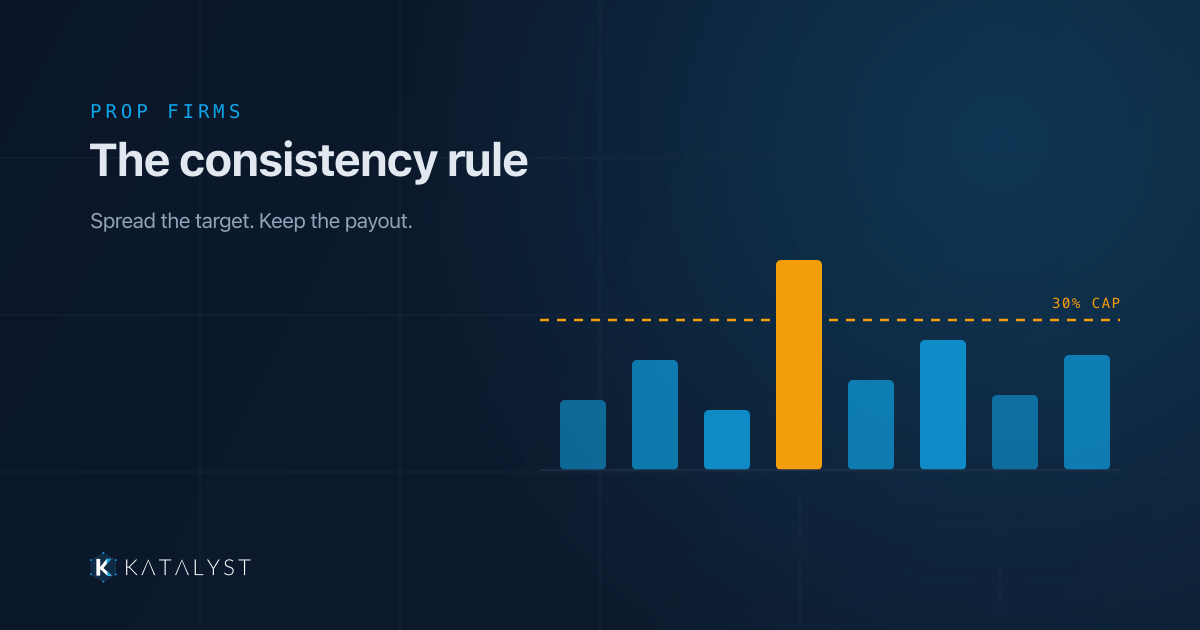
You can hit the profit target, respect the drawdown, and still fail a prop firm evaluation. The rule that catches traders off guard isn’t the loss limit — it’s the consistency rule, and by 2026 nearly every futures evaluation has some version of it. Understanding it is the difference between a payout and a reset.
What the consistency rule actually caps
The consistency rule limits how much of your total profit is allowed to come from a single day. Most firms cap it at 30–40% of cumulative profit. The math is simple and unforgiving:
- Bank $1,000 total, and your single best day can’t exceed $300 (at a 30% cap).
- Bank $3,000 total, and your best day cap rises to $900.
One exceptional session that accounts for 60% of your target doesn’t read as consistency — it reads as a lucky trade. The firm is underwriting whether you can repeat results, not whether you can catch one home run.
Here’s the trap: the cap is checked against your final total, not your total on the day you traded. A $900 day feels safe when you’re up $4,000. If the evaluation ends with you up $2,500, that same $900 day is now 36% of the total — and it’s a violation.
Why it exists (and why it’s actually good for you)
Firms added consistency rules because a funded account is a risk transfer. They pay real money on withdrawals, so they want traders whose edge shows up across many sessions, not gamblers who spiked once and will eventually revert. The rule filters for exactly the behavior that survives after funding.
That’s the reframe worth internalizing: the consistency rule isn’t an obstacle to your edge, it’s a description of what a real edge looks like. A trader with genuine expectancy across dozens of trades passes it without trying. (If you’re fuzzy on why expectancy beats a hero day, our post on metrics that actually matter breaks it down.)
How to trade so the rule never bites
1. Spread the target across more days. If the cap is 30%, you need at least four solid green days to clear it cleanly. Aim for smaller, repeatable wins instead of swinging for the target in one session.
2. Cap your daily upside on purpose. When you’re having a monster day, that’s the day the rule is most dangerous. Bank the win and stop — a green day you walk away from can’t blow your distribution.
3. Size for survival, not speed. Oversizing is the #1 reason evaluations fail, and it’s also what creates the outlier day that breaks consistency. Risking 0.25–0.5% per trade keeps any single day from dominating your total. Run the numbers before you place the trade with the risk/reward simulator and the position size calculator.
Track your distribution before payout day
The failure mode is discovering your best day is over the cap after you’ve hit the target. You want to see the distribution building in real time.
That’s a data problem, and it’s exactly what a journal fed by automatic Rithmic sync solves. Every fill lands in Katalyst automatically, so your per-day P&L is always current — no reconstructing the week from broker statements. From there, the P&L analysis view shows your daily contributions at a glance, and the pivot grid lets you slice profit by day to check your single best day against the cap.
| Cumulative profit | 30% cap on best day | 40% cap on best day |
|---|---|---|
| $1,000 | $300 | $400 |
| $2,500 | $750 | $1,000 |
| $5,000 | $1,500 | $2,000 |
The consistency rule doesn’t ask you to trade smaller. It asks you to prove your edge is real. Traders who track their daily distribution never get surprised by it.
Pass the rule you can see coming
Read your firm’s exact consistency percentage before you place a single trade — the number varies, and a few points matter. Then keep a journal that shows your daily profit distribution as it forms, so payout day is a formality instead of a gamble.
Connect your account to Katalyst, let it pull every fill automatically, and watch your consistency build one green day at a time.